

Quick answer: A low-calorie dog treat is a small piece with only a few calories, ideally under about 5 for training-size rewards. Our freeze-dried bonito cubes are about 3 calories each and our tuna about 6, compared with about 40 for a medium Milk-Bone biscuit. Whatever you feed, keep all treats under 10% of your dog’s daily calories. For a 10 kg (22 lb) dog, that is about 59 calories a day, or roughly 19 bonito cubes.
Calories per treat: our three fish
Every Sea Bites treat is one wild-caught fish and nothing else, so the calorie count is simply the fish. Here is exactly what each piece costs your dog’s daily budget.
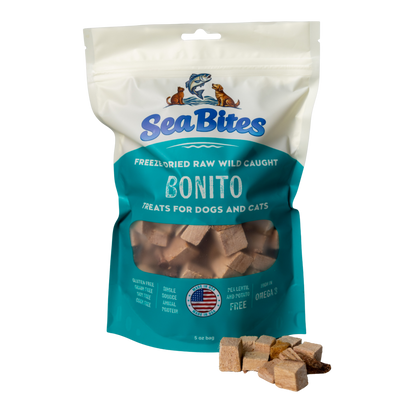
3kcal
Bonito Cubes
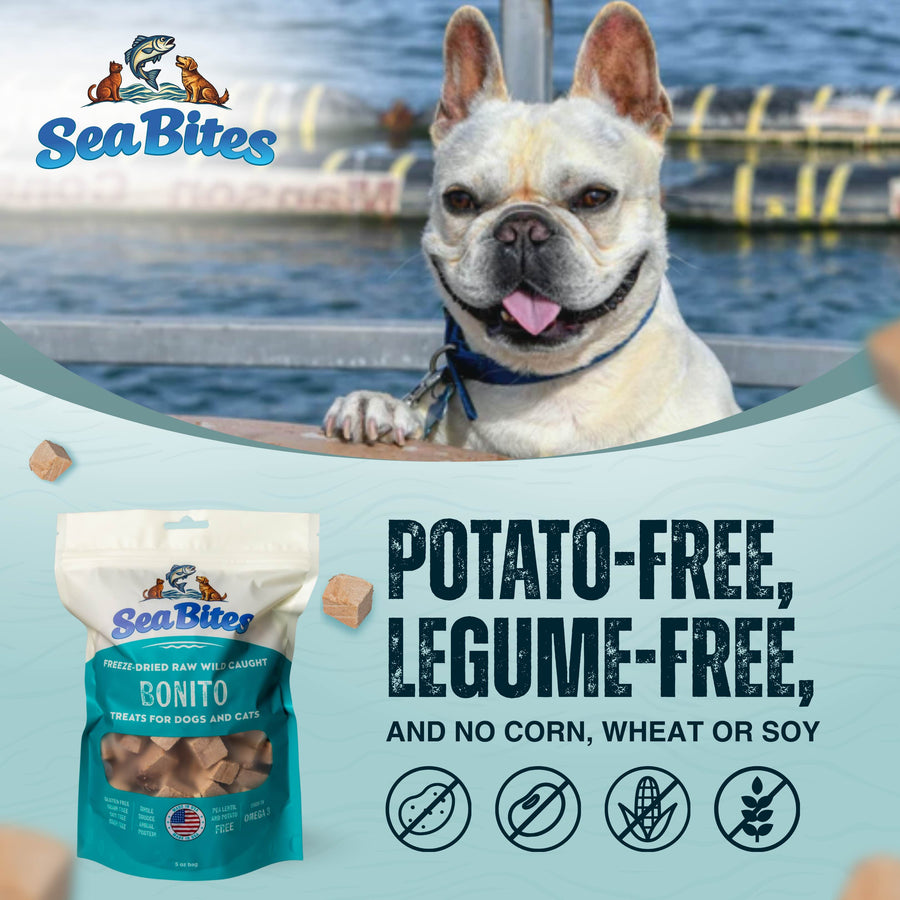
Lowest per piecePer 1 g cube. About 140 cubes in a 5 oz bag. 68% protein, 4% fat.
Shop bonito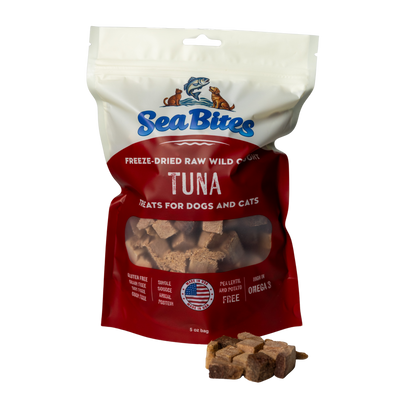
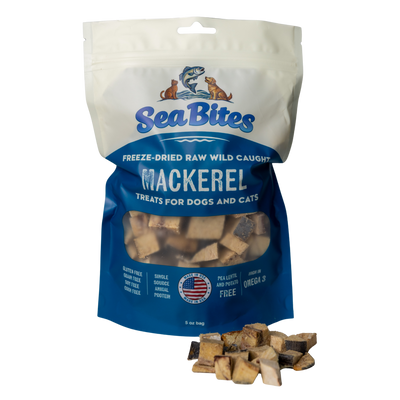
11kcal
Mackerel
Not low-caloriePer piece. Rich in omega-3 at 20% fat. Use it as an occasional jackpot, not an everyday reward.
Shop mackerelIf you are counting every calorie, bonito is the best choice for training and tuna is the best choice for dogs that also need a low-fat treat. Both are in our low-calorie dog treats collection.
What makes a dog treat low-calorie?
There is no official calorie cut-off for a “low-calorie” dog treat, so the words on the bag tell you very little. Three things actually decide how many calories your dog gets.
Calories per piece, not per bag. The number that matters is how many calories each reward adds. Freeze-dried fish is actually dense by weight, at about 300 calories per 100 g for bonito and tuna, but each cube weighs so little that a single reward is tiny.
Fat. Fat carries about 9 calories per gram, against about 4 for protein. That is why lean tuna at 3% fat has only a little over half the calories per gram of mackerel at 20% fat.
Size and how many you give. A 3-calorie cube given 30 times is 90 calories. Dogs care much more about getting something tasty than about how big it is, so small pieces give you more rewards for the same budget.
Check the label for “kcal per treat.” Most reputable brands print it near the guaranteed analysis. If a bag only gives kcal per kg, divide by the number of treats per kg, or skip it. Our guide on how to read a dog treat label shows where to look.
The 10% rule for dog treats
10%
Treats should make up no more than 10% of your dog’s daily calories.
The other 90% should come from a complete, balanced dog food. When you give treats, reduce meals by the same number of calories rather than adding treats on top.
This matters because most dogs are already carrying extra weight. In the Association for Pet Obesity Prevention’s most recent veterinary survey, 59% of US dogs were classified as overweight or obese, and owners often did not realize it. Treats are one of the easiest places for extra calories to hide, because nobody writes them down.
The good news is that the rule does not mean fewer rewards. It means smarter ones. Swap one medium biscuit (about 40 calories) for low-calorie cubes, and you can give your dog 13 rewards instead of one.
How many treats can my dog have? Calorie table by weight
Find your dog’s weight to see the daily treat budget and how many pieces of each Sea Bites fish fit inside it.
Swipe the table sideways to see pieces per fish.
| Dog weight | Daily calories (approx.) | Treat budget (10%) | Bonito cubes (3 kcal) |
Tuna pieces (6 kcal) |
Mackerel pieces (11 kcal) |
|---|---|---|---|---|---|
| 2.5 kg / 5.5 lb | 210 | 21 kcal | 7 | 3 | 1 |
| 5 kg / 11 lb | 350 | 35 kcal | 11 | 5 | 3 |
| 10 kg / 22 lb | 590 | 59 kcal | 19 | 9 | 5 |
| 15 kg / 33 lb | 800 | 80 kcal | 26 | 13 | 7 |
| 20 kg / 44 lb | 1,000 | 100 kcal | 33 | 16 | 9 |
| 25 kg / 55 lb | 1,170 | 117 kcal | 39 | 19 | 10 |
| 30 kg / 66 lb | 1,350 | 135 kcal | 45 | 22 | 12 |
| 40 kg / 88 lb | 1,670 | 167 kcal | 55 | 27 | 15 |
| 50 kg / 110 lb | 1,970 | 197 kcal | 65 | 32 | 17 |
Daily calories are an estimate for a typical adult pet dog with moderate activity. Puppies, working dogs and very active dogs need more; less active, older and neutered dogs often need less. If your dog is on a weight-loss plan, your vet will usually set a lower daily target, so use their number and take 10% of it. The budget covers all treats combined, including chews and table scraps.
How many calories are in popular dog treats?
This is where the 10% rule gets real. The chart shows how much of a 10 kg (22 lb) dog’s 59-calorie daily treat budget one piece of each treat uses up. Where a brand makes sizes, we used the size the brand recommends for a dog that weight.
None of these treats are “bad.” A dental chew does a job a fish cube cannot, and plenty of dogs get one every day. The point is to count it: if your dog has a 53-calorie dental chew, there are only about 6 calories left for everything else that day.
Low-calorie treats from your kitchen
Some fruit and vegetables make good low-calorie extras. Wash them, cut them small, and count them in the budget like any other treat.
~4
Baby carrot
kcal each, and crunchy
~1
Blueberry
kcal each, easy to scatter
~2
Green bean
kcal each, plain and cooked or raw
~1
Cucumber slice
kcal each, mostly water
~12
Apple slice
kcal per eighth, seeds and core removed
Never give: grapes or raisins, onion, garlic, chocolate, macadamia nuts, or anything containing xylitol, a sweetener found in some sugar-free gum and peanut butters. All of these can be toxic to dogs.
7 ways to cut treat calories without cutting treats
- Measure the daily food, then subtract the treats. If your dog gets 60 calories of treats, take 60 calories off their meals.
- Count out the day’s treats each morning. Put the daily budget in a jar. When the jar is empty, treats are done for the day.
- Go smaller. Break cubes in half. Half a bonito cube is about 1.5 calories and still a reward.
- Swap one big treat for several small ones. One medium biscuit equals about 13 bonito cubes.
- Use part of the daily kibble for easy cues. Save the fish for hard work, like recall at the park. More ideas in how to use dog treats during training without overfeeding.
- Agree on one family budget. Everyone gives treats from the same jar, so nobody doubles up.
- Reward with more than food. Praise, a game of tug or a sniff on a walk all count as rewards and cost nothing.
Low-calorie rewards dogs actually want
One wild-caught fish per bag, freeze-dried in the USA, with nothing else on the label. Strong-smelling enough for picky dogs, small enough for long training sessions.
Training every day? Our 24 oz bulk bags cost less per ounce. See every option in our training treats collection.
This article is for general information and is not a substitute for advice from your veterinarian, especially if your dog is on a weight-loss plan or has a medical condition.
Frequently asked questions
What are the best low-calorie dog treats?
Small, single-ingredient treats with a stated calorie count of a few calories per piece, plus plain vegetables like baby carrots and green beans. Our freeze-dried bonito cubes are about 3 calories each and our tuna about 6, with nothing added. Whatever you choose, keep the total under 10% of daily calories.
How many calories should a dog treat have?
For training rewards you give many times a day, aim for under about 5 calories a piece. For a once-a-day chew, check that it fits within your dog’s 10% treat budget along with everything else. A 10 kg (22 lb) dog has roughly 59 treat calories a day.
What is the 10% rule for dog treats?
Treats, chews and table scraps together should make up no more than 10% of your dog’s daily calories. The rest should come from a complete and balanced dog food, reduced to make room for the treats.
How many treats a day is too many?
It depends on the treat, not the number. Thirty 3-calorie cubes is about 90 calories, which fits a 20 kg (44 lb) dog’s budget. One 88-calorie bully stick is already over the budget for a 10 kg dog. Check the calorie table by weight above.
Are freeze-dried treats low in calories?
Per piece they can be. Freeze-dried meat and fish are calorie-dense by weight because the water is gone, but the pieces are light, so each one is small. Lean fish like bonito and tuna are much lower per piece than fatty options. More on freeze-dried treats as everyday rewards.
What are good low-calorie treats for dogs on a diet?
Lean, single-ingredient treats broken into small pieces, plus plain vegetables such as green beans and baby carrots. Ask your vet for your dog’s target daily calories, take 10% of that as the treat budget, and reduce meals to match.
Are low-calorie treats good for training?
Yes. Training uses lots of rewards, so a low-calorie piece lets you reward often without overfeeding. Strong-smelling treats like fish also hold attention in busy places. See our training treats.
Are low-calorie treats also low-fat?
Not always. A treat can be low in calories per piece simply because it is small, while still being high in fat by weight. If your dog needs low fat, check the fat percentage too. Our tuna is 3% fat and is our first choice for sensitive stomachs.
Sources
- Association for Pet Obesity Prevention. 2022 Pet Obesity Prevalence Survey.
- Freeman LM, Janecko N, Weese JS. Nutritional and microbial analysis of bully sticks. Canadian Veterinary Journal, 2013. Summary from Tufts University.
- Manufacturer calorie statements for Milk-Bone Original Medium and Greenies Original Petite, October 2026.
- USDA FoodData Central, for fruit, vegetable, peanut butter and cheese values.
- Sea Bites Treats product pages, for bonito, tuna and mackerel calories.